

A casino review is worth trusting when it shows its work. This means disclosing who pays for it, stating what was actually tested and how, naming the licensing bodies that operators claim, and carrying a visible date showing when it was last looked at. Everything else is decoration. If a page hands you a score out of ten with no visible basis for it, you have learned nothing about the casino and something about the publisher. This piece is the checklist we would want a reader to run before trusting anyone’s verdict, including ours.
The Checklist: What a Trustworthy Review Actually Shows
Four things, and you can check all four in about two minutes.
It discloses its commercial relationships. Casino content is monetised through affiliate links almost everywhere, and that is not automatically a problem. The problem is silence about it. A review that earns commission when you sign up should say so plainly, the way our own desk explains its funding on our who-runs-this-desk page. Disclosure does not make a review honest. Its absence makes the review’s silence suspicious.
It states its testing method. “We tested this casino” means nothing on its own. What was opened, what was deposited, which games were played, how long a withdrawal took? A review that describes its process lets you judge whether the process was any good. A review that skips straight to a star rating is asking you to trust a conclusion with no visible path to it. The full framework for how weighted scoring works belongs to our casino review methodology breakdown, so we will not rebuild it here.
It names licensing bodies without overclaiming. A useful review tells you which regulator an operator claims to be licensed by. The actual regulators to look for are the Malta Gaming Authority, the UK Gambling Commission, and the Government of Curaçao. What it should not do is imply it independently re-verified that operator’s current licence status on the day you are reading. Licence status changes, and no review desk is re-checking every register daily. The standard approach involves naming the body, describing what the operator states, and not dressing it up as independent verification.
It shows a last-updated date. Bonuses change, payment providers get dropped, licensing shifts. A review with no visible review date is a snapshot with the timestamp torn off. You cannot tell whether you are reading something from last month or three years ago, and neither can the person who wrote it.
If a review clears those four, you can start reading its actual findings. If it fails them, the findings do not matter much.
What a Review Should Actually Cover
A serious review walks through the same handful of areas every time, in enough depth that you can tell the writer actually looked. Each section below shows what to look for and what a thin version of it looks like.
Licensing and Security
The review should name the regulator the operator states it is licensed by, and explain what that regulator actually requires. A Curaçao licence and a UK Gambling Commission licence impose different requirements on operators. A review that treats them as interchangeable has misled you. What you want is the name, the jurisdiction, and a plain description of what that means for dispute resolution if something goes wrong. What you do not want is a badge graphic and the word “secure.”
Game Selection and Providers
Pay attention to which studios are actually in the lobby. A raw game count means little without knowing which developers made them. A library of thousands of titles from a handful of unknown providers is a different product from a smaller lobby carrying the studios you already know. A useful review names specific providers and specific games, so you can check whether the thing you actually want to play is there. Generic language about which developers run the games—without naming actual studios or titles—conveys no useful information.
Bonuses and Terms
Every bonus has terms, and the terms are the bonus. A review should state the wagering requirement, the time limit, the maximum bet while wagering, and which games count toward clearing it. A headline offer with no terms attached is marketing copy, not a review. Watch for reviews that quote the headline percentage and stop there.
Payment and Payout Speed
Payment speed is where many reviews gloss over details, yet this is exactly where the information matters most. You want to know which deposit methods are supported, what the minimums are, whether fees apply, and how long a withdrawal actually took for the person writing. The key figure is the actual withdrawal time the writer experienced, based on real testing and direct observation of the platform. Some reviews now cover crypto payment speed and fees as one factor worth checking alongside cards and e-wallets, since withdrawal times and fee structures vary by operator and by method. If that angle is the one you care about, crypto casino sites are covered in more depth elsewhere. Does the review give you a number for how long a cashout took, or does it just repeat what the operator’s website promises?
Mobile Experience
Most people reading a casino review will play on a phone. A review should say whether the site works in a mobile browser, whether there is an app, and whether anything is missing on the smaller screen. This is easy to test and easy to fake, which makes it a decent signal of whether the writer did anything at all.
Customer Support
Which channels exist, what hours they run, and how long a response took. A review that mentions “24/7 live chat” should include the actual response time, since stating availability is different from documenting real support speed.
Responsible Gambling Tools
Deposit limits, session timers, self-exclusion, and links to support organisations such as GamCare or their equivalents. A review that skips this section entirely is telling you something about its priorities. Tools like these are the difference between a product built for sustained play and one built for extraction, and a review should say which it found.
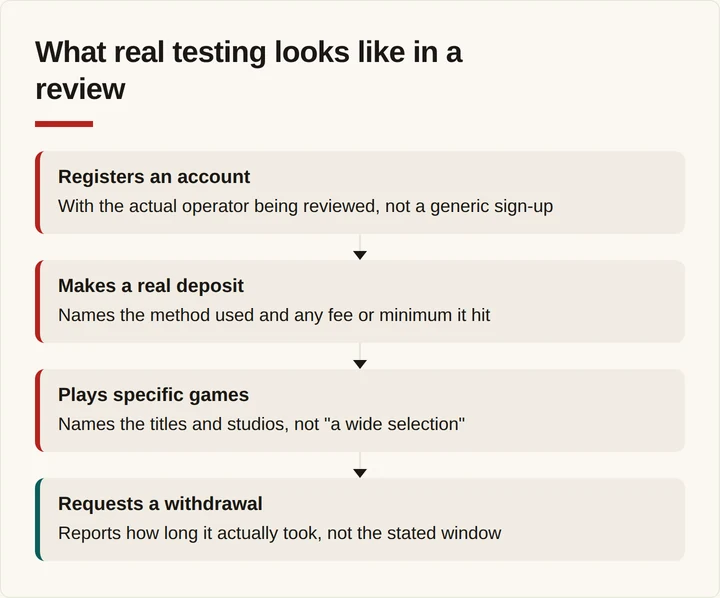
How to Tell If a Review Actually Tested the Platform
A review built on real testing will mention registering an account, making a deposit, playing specific games, and requesting a withdrawal. It then reports how long the withdrawal took. This paper trail of specific actions and results is the evidence of actual work. Those four steps leave marks a writer cannot fake convincingly. Look for a specific deposit method, a named game, an actual wait time. A review that describes the platform only in terms any press release could supply has probably not been near it. The full behind-the-scenes breakdown of what that process looks like lives in our real money testing piece, so we will leave it there.
User Reviews vs. the Professional Write-Up
Use both, and weight them differently. User reviews are good at surfacing what a platform feels like over weeks: whether withdrawals actually land, whether support answers, whether a bonus term turns out to be a trap in practice. They are bad at context, because a single angry reviewer has no idea whether their experience was typical. Professional reviews are good at structure and comparison, and bad at catching the slow-burn problems that only show up after a month of play. Read the professional write-up for the framework, then read the user reviews for the texture, and treat a pattern across many user reviews as more meaningful than any single one. Our user reviews vs professional analysis comparison covers the full version of that argument.
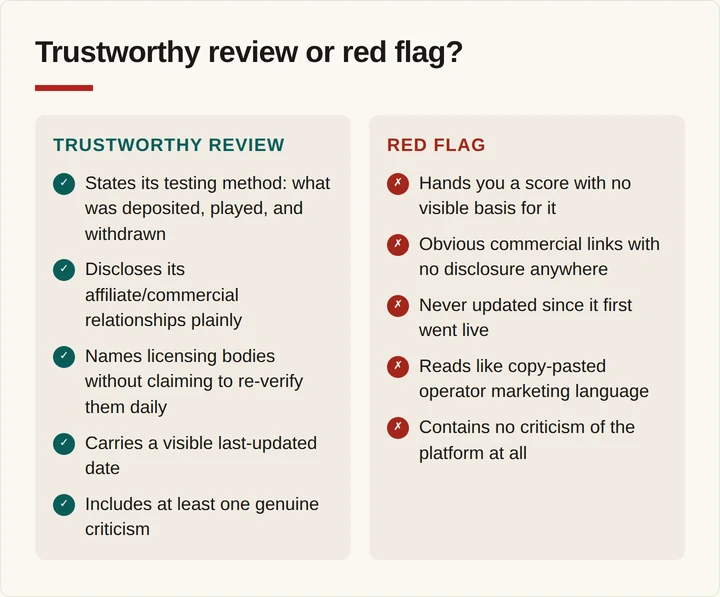
Red Flags: When a “Review” Isn’t One
These signals are fast to spot and hard to argue with, and they deserve to stick in your memory.
Affiliate links present without disclosure. If every operator mentioned has a sign-up button and the page never states it earns commission from those clicks, the disclosure is missing on purpose.
No stated testing method. No deposit, no game names, no withdrawal time, no screenshots of anything a person would actually see. The review describes the platform the way its own marketing does.
Never updated since launch. Check the date, if there is one. A review that has sat untouched while the operator changed its bonus, its payment providers, and possibly its licensing has become an outdated artefact, no longer representing current conditions.
Copy-pasted operator language. When the same broad descriptive phrases appear in both the review and the operator’s promotional materials, that’s a strong sign the text was copied. Independent assessment sounds like someone describing what they found, including the parts that annoyed them.
No negatives at all. Every platform has tradeoffs. A review with nothing critical in it is either written by someone who did not look or someone who did not want to say.
A score with no arithmetic. If the review ends in a rating out of ten and you cannot reconstruct how it got there from what you just read, the number was decoration.
A Quick Checklist Before You Trust Any Review
Run these in order. The first two take seconds.
- Is the affiliate relationship disclosed somewhere visible?
- Is there a last-updated date, and is it recent?
- Does the review state what was tested and how?
- Does it name the licensing body without claiming to have re-verified it?
- Does it give a real withdrawal time rather than the operator’s stated window?
- Does it list bonus terms, not just the headline offer?
- Does it name specific game providers and titles?
- Does it mention responsible gambling tools?
- Does it contain at least one criticism?
- Can you trace the final score back to the evidence in the piece?
Any single failure is survivable. Three or more and you are reading marketing with a review’s layout.
The Bottom Line
Trust a casino review the way you would trust any other piece of work. Check whether it shows its method, names its funding, dates itself, and lets you check its reasoning. That standard is the one we hold our own pages to, and it is the reason we describe what operators state about their licensing rather than claiming to verify it ourselves. You do not need to know which review desk is honest. You need to know which questions separate a review from an advertisement, and then ask them every time.