

Real money testing is the one part of a casino review that can’t be assembled from a press kit. We open an account with our own funds, deposit, play, contact support, and request a withdrawal, then write down what happened at each step. Everything else in a review, from the licence check to the game-provider list, can be done from a desk with a browser and a few official documents. The test run is the only stage where the reviewer’s money is actually on the line, and the only stage that ends with a payout landing in a real account. It sits at the centre of our work because it’s the only stage that can’t be faked by someone working from a desk without ever depositing.
Walking Through an Actual Test Run
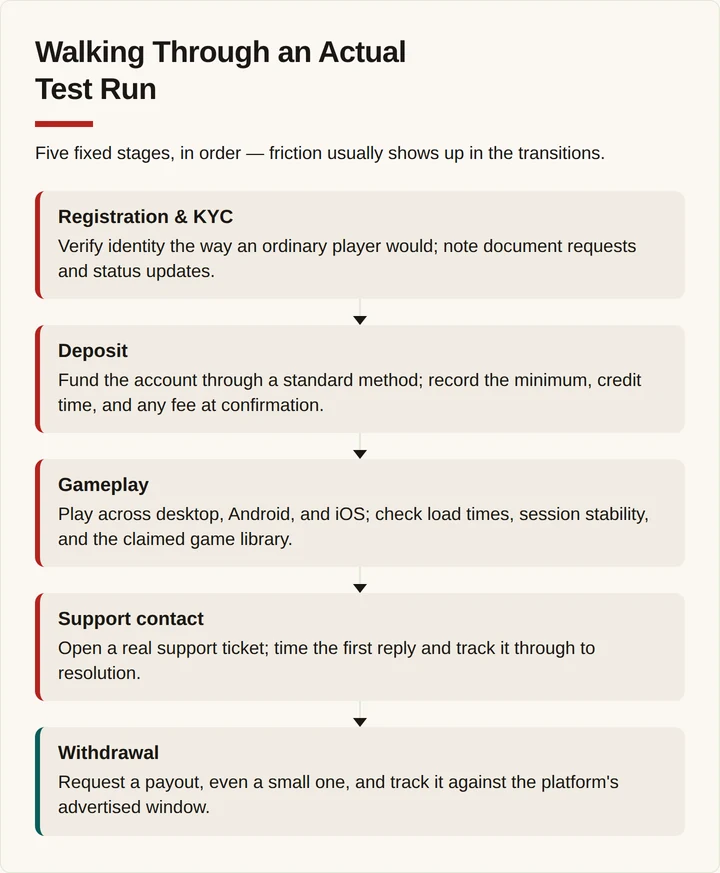
A test run moves through five stages in a fixed order: registration and verification, deposit, gameplay across devices, a support contact, and a withdrawal request through to payout. We follow these stages in order because friction emerges at the transitions. The withdrawal stage is where platform behavior reveals most clearly.
Registration and KYC. We create the account the way an ordinary player would, with real details, and we note how long verification takes and what the platform asks for. Some ask for ID documents up front, others defer them until the first withdrawal request. The timing shapes the player’s experience at different stages. A long approval at signup creates onboarding friction. A long approval at withdrawal stalls a payout after funds are already deposited. We watch for how many separate documents get requested, whether the upload flow works on a phone, and whether the status updates or stays static.
Deposit. We fund the account through a standard method, card, e-wallet, or crypto, and we record the minimum, the time to credit, and any fee that surfaces at the confirmation screen. The confirmation often reveals fees that don’t appear in the published terms. Advertised deposit limits frequently differ from what the cashier actually imposes when you select a payment method. Fast credit matters most for live-dealer tables like Live Roulette, where a delayed deposit can mean missing the session entirely.
Gameplay. We play on desktop, Android, and iOS, and we watch for load times, whether the lobby search behaves the same across devices, and whether a session survives a network drop. A slot that runs smoothly on a laptop and stutters on a mid-range phone signals a platform or device-compatibility issue, and it only shows up if you actually switch devices mid-test. We also note whether the game library matches what the platform claims to carry. Marketing pages and the live lobby often list providers differently. We look for specific titles from studios like NetEnt, Pragmatic Play, Evolution Gaming, and Yggdrasil to verify the claimed inventory matches the actual lobby. A lobby that claims to carry Book of Dead but doesn’t is a finding worth recording.
Support contact. We open a live chat with a real question, usually about a bonus term or a pending withdrawal, and we time the first response and the resolution. What matters is whether the chat closes the ticket. Reaching a resolution provides value to the player. The final outcome determines the test result; initial response speed is secondary. This difference only emerges when you stay in the conversation until closure or the loop repeats.
Withdrawal. We request a payout, even a small one, and we track it against the advertised window. This is the stage that determines the review outcome. A platform that takes deposits instantly and then sits on a withdrawal for days past its own stated timeline reveals the core operation, regardless of how the lobby looks or flows.
What This Catches That Nothing Else Can
The method catches things a desk review structurally cannot, because the reviewer’s own funds are committed from deposit through withdrawal. Real-money testing eliminates two common sources of bias. Testing with cash removes the influence of affiliate promotions by requiring the tester to play on a real balance, separate from any promotional bonuses. Testing with cash also activates the verification, payment, and support systems, which demo play cannot trigger. It also covers the full player journey across all touchpoints. KYC delays, payment speed, bonus restrictions, and support responsiveness all live outside the lobby, and none of them appear in a screenshot of a game grid. A platform with a deep game library can still run a withdrawal process that takes a week longer than advertised, and only a live test surfaces both realities in the same review.
Accountability is harder to measure but real. Operators know a public writeup is coming, and the knowledge that a reviewer is moving real money through the system changes how they handle it. We maintain confidentiality about the test and accept only standard-player access, yet the fact that a review will exist at the end shapes how the process proceeds and produces more reliable results.
The Table Every Test Fills In
Every test run produces the same set of recorded fields, and the table below is the shape we fill in as we go, completed in real time. The categories track the staged walkthrough above, so each row maps to a moment in the run where we have concrete proof in timestamps and screenshots. We keep the record deliberately narrow. It captures what happened during each stage. Analysis belongs in the writeup; raw facts belong in the file.
| Stage | What we record | What it tells us |
| Registration & KYC | Time to verify, documents requested, whether status updates | Whether onboarding friction is front-loaded or deferred to withdrawal |
| Deposit | Method used, time to credit, minimum applied, any fee shown at confirmation | Whether the cashier matches the published terms |
| Gameplay | Devices tested, load behaviour, session stability, lobby vs. claimed library | Whether the platform performs the same way across the devices players actually use |
| Support | Time to first reply, time to resolution, whether the issue closed | Whether support solves problems or just answers them |
| Withdrawal | Request time, approval time, payout arrival vs. advertised window | Whether the platform pays out on the terms it publishes |
The withdrawal row decides the review, and everything above it explains why that row came out the way it did. Each combination of findings tells its own story. Fast payouts pair with KYC friction in one narrative, smooth onboarding combines with slow payouts in another, and the full range exists between them. The table preserves these distinct narratives in separate rows.
Problems a Live Test Surfaces That a Desk Review Misses
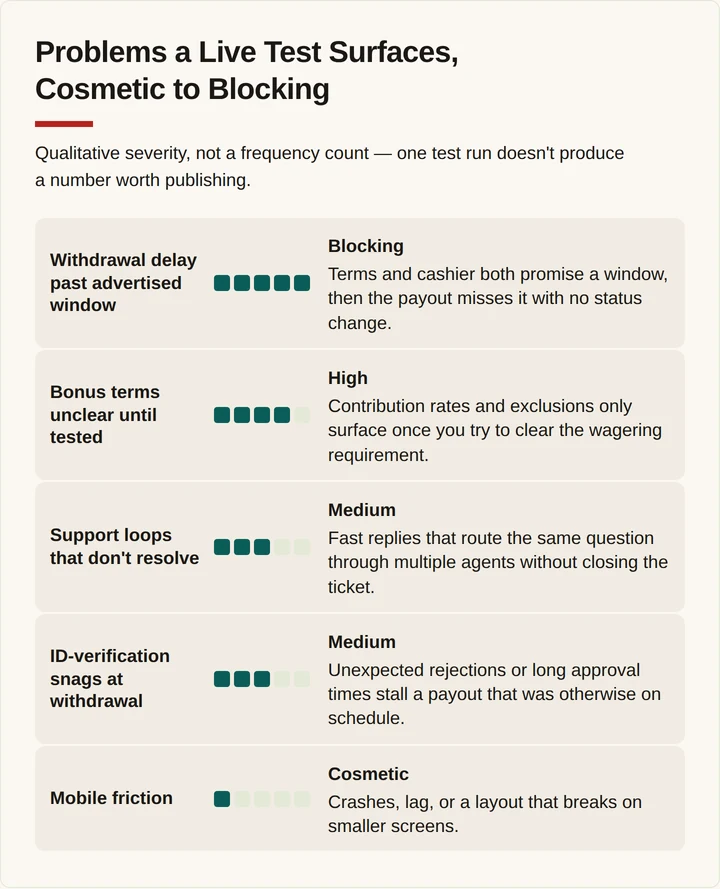
The problems a live test surfaces tend to cluster in the same places. Problems stay invisible until cash actually moves through the system. A delayed withdrawal against an advertised payout window is the clearest example. The terms page states a window, the cashier confirms it, and then the payout arrives later than both, with no status change in between. That gap is the finding.
Bonus terms are the second cluster. A wagering requirement reads one way on the promotions page and behaves another way once you try to clear it, because the contribution rates per game, the maximum bet while a bonus is active, and the expiry clock all interact in ways the summary doesn’t spell out. You only find the edge cases by playing through them with a real balance—a Starburst slot might contribute 100% toward the requirement, and a table game from a studio like Pragmatic Play might contribute nothing at all. A difference no terms page makes obvious. Support loops are the third problem. A chat that responds quickly but routes the same question through three agents without resolving it is a support failure that looks like a support success on a response-time metric. Mobile friction is the fourth, manifesting as crashes, lag, or layouts that break on smaller screens, which desktop-only reviews miss. ID-verification snags round it out, since an unexpected rejection or a long approval time at the withdrawal stage can stall a payout that was otherwise on schedule. We track these as qualitative grades from cosmetic to blocking, using descriptive severity levels that reflect what a real player experiences. Qualitative grades fit a single test run, since it doesn’t produce a frequency count worth publishing. The severity ladder below shows how we sort them when writing up.
Running a Test Without Compromising It
Running a test without compromising it comes down to discipline in six areas, and the first is device coverage. Testing on desktop alone misses the mobile problems that most players will actually hit, so we run the same session on desktop, Android, and iOS and compare notes across all three.
Timestamping is the second. We record the moment of deposit, the moment of withdrawal request, and the timestamps on every support reply. A payout that felt slow becomes a documented finding once the timestamps show it landed well past the platform’s own advertised window. Screenshots are the third. We save visual proof of the cashier screen, the confirmation, and the chat transcript in real time, captured as each stage completes.
The fourth is confidentiality. We conduct the test as a standard player, announce nothing to the operator, ask for no special treatment, and accept only the standard account and testing access an ordinary player receives. The fifth is actually withdrawing. A test that deposits and plays without requesting a payout has omitted the only stage that decides the review, so we always request a withdrawal, even a small one, and follow it to arrival. The sixth is the paper trail. Every support interaction gets saved, every confirmation gets captured, and the whole record stays with the test file. That record is what lets us write a specific, evidence-backed finding, and it’s what makes the difference between a review that did the work and one that says it did.

Where the Method Has Limits
A single test run is a point-in-time, single-account snapshot. It reflects one reviewer’s experience on one day, with one set of documents and one payment method, and it doesn’t guarantee consistent performance beyond that single run. A platform that pays out cleanly for us on a Tuesday may behave differently for a player in another country, on another payment rail, or during a busier period, and we can’t see any of that from one account. It also doesn’t replace a full disclosed-methodology review. A scaled methodology checks licensing, ownership, and game-provider fairness across many criteria at once, and it produces a weighted score that a single test run can’t generate on its own. That full scoring framework belongs to our casino review methodology breakdown. The test run and the methodology address different questions. The test run tells you what happened to one player on one day. The methodology shows you how the platform is structured and whether the pieces hold together.
The test run is the most vivid part of a review and the least generalisable. It earns its place as the only stage that can’t be faked. The test run serves as one input among several in a complete review. Readers who want the full picture should combine the test run with other verification methods. The reader-facing checklist for judging any casino review is the place to start if you want to know how to tell whether a review actually did the work. For the broader question of how user reports and professional analysis differ, our comparison of user reviews and professional analysis covers that ground separately.
Keeping It Honest
Disclosing where the money came from is essential. We test with reviewer-owned funds, and we say so. A test funded by an operator or an affiliate deal transforms into a promotional piece. We also avoid VIP accounts and custom testing perks, because reviewing special access provides no useful comparison to ordinary players’ experiences. Documentation is the second pillar. We keep proof where we can, screenshots and timestamps and chat transcripts, and we document both strengths and weaknesses with equal detail. A review that only lists problems is as useless as one that only lists praise; both require the same specificity.
The third pillar is the reader’s ability to check our work. That’s what the checklist on our reader-facing review checklist is for, and it’s also why we publish how the desk earns money. A review you can’t audit is a review you have to take on faith, and faith isn’t a method.
The One Part That Can’t Be Faked
Real money testing is the one part of a casino review that can’t be assembled from a press kit, a licence lookup, or a lobby screenshot. It requires a reviewer to open an account, deposit their own funds, play across devices, contact support, and request a withdrawal through to payout, then write down what actually happened. That process catches things a desk review structurally misses, from delayed payouts against an advertised window to bonus terms that only become clear once you try to clear them. The method has limits. One run is one snapshot, and it doesn’t replace a full methodology review. But it’s the stage where the reviewer’s money is on the line, and the financial commitment is what enables the findings that follow.